

In the workspace
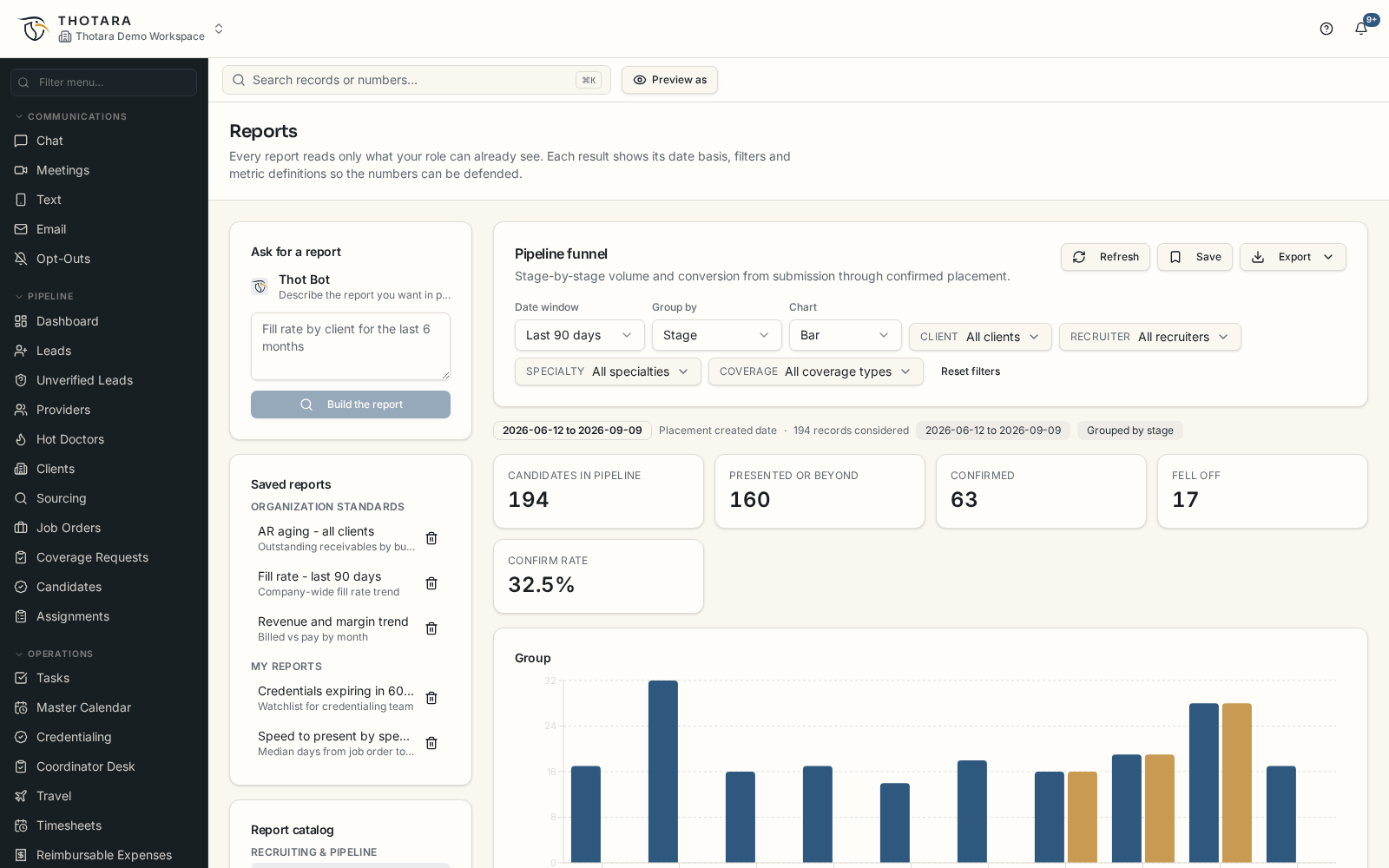
Margin and fill rate you can defend
Pipeline funnel, fill rate, revenue and margin trend — every report shows its date basis, filters and metric definitions, and you can ask for a custom report in plain language.
Capabilities
From submitted hours to collected revenue
Rate cards, not a single rate
Compose hourly, daily, per-shift, 24-hour call, beeper/standby, procedure and gratis-hour components on one job order.
Asymmetric pay vs bill
What the provider earns and what the client is billed are separate structures — different units, different premiums, different minimums.
Timesheets from the provider
Providers submit hours in their portal against the actual schedule, with call and beeper hours captured separately.
Client approval flow
Facility approvers review and approve hours in the client portal, creating the paper trail before anything is invoiced.
Invoicing from approved hours
Invoices build from approved time with the right premiums, expenses and travel pass-throughs applied automatically.
Provider pay and direct deposit
Pay calculations from the same approved hours, plus signed direct-deposit authorizations stored with reveal-logged bank data.
Agreements that match the invoice
Confirmation letters, letters of agreement and PSAs carry the same rate terms the invoice bills, signed and event-logged.
Margin visibility
Gross margin per assignment, client, recruiter and desk — including travel and expense drag, not just spread on the hourly rate.
Rate structures supported
Built from real locums contracts
- Hourly with minimum guaranteed hours
- Daily and per-shift flat rates
- 24-hour call coverage rates
- Restricted and unrestricted beeper/standby differentials
- Gratis or non-billable hours agreed with the client
- Overtime, weekend and holiday premiums
- Travel days, orientation hours and EMR training time
- Expense pass-throughs, markups and caps
- OT & holiday
- Premiums applied per rule, on both pay and bill sides
- Gratis hours
- Modelled explicitly instead of discounted by hand
- One source
- Approved hours drive pay, bill and margin together
One approval chain
The provider submits hours against the scheduled shifts. The facility approver signs off in their portal. Accounting invoices from that approved set and pays from the same set. There is no second entry point where the numbers can diverge, and every step is time-stamped for dispute resolution.
Questions
What finance teams ask
Can it handle 24-hour call with a beeper differential?
Yes. Call coverage, in-house call, restricted beeper and unrestricted beeper are separate rate components with their own units and premiums on each side of the transaction.
What about 1099 versus entity billing?
Both branches are supported end to end, including the correct agreement template, tax handling fields and payment path for each.
Do we still export to accounting?
Invoices and pay data are exportable, so your accounting system remains the ledger while Thotara stays the operational source of the hours.
Who can see bank details?
Only roles that need them, and every reveal is written to the audit log with the user and timestamp.